Upload Process
Section titled “Upload Process”Only Project Administrators can upload new Systematic Searches. The upload process follows a wizard to guide you through importing your reference file. This is a three-step process for .csv files (Basic, Screening, and Upload) and a two-step process for .xml and .ris files (Basic and Upload, as the screening step is skipped).
Contents
Getting Started
Section titled “Getting Started”- Navigate to the desired project within SyRF.
- In the left-hand project navigation panel, expand the Studies section.
- Click on Systematic Searches.
- Click the Import a search button to launch the wizard.
Wizard Step 1: Basic Information
Section titled “Wizard Step 1: Basic Information”In the first step, you will provide essential details about your search and select your file
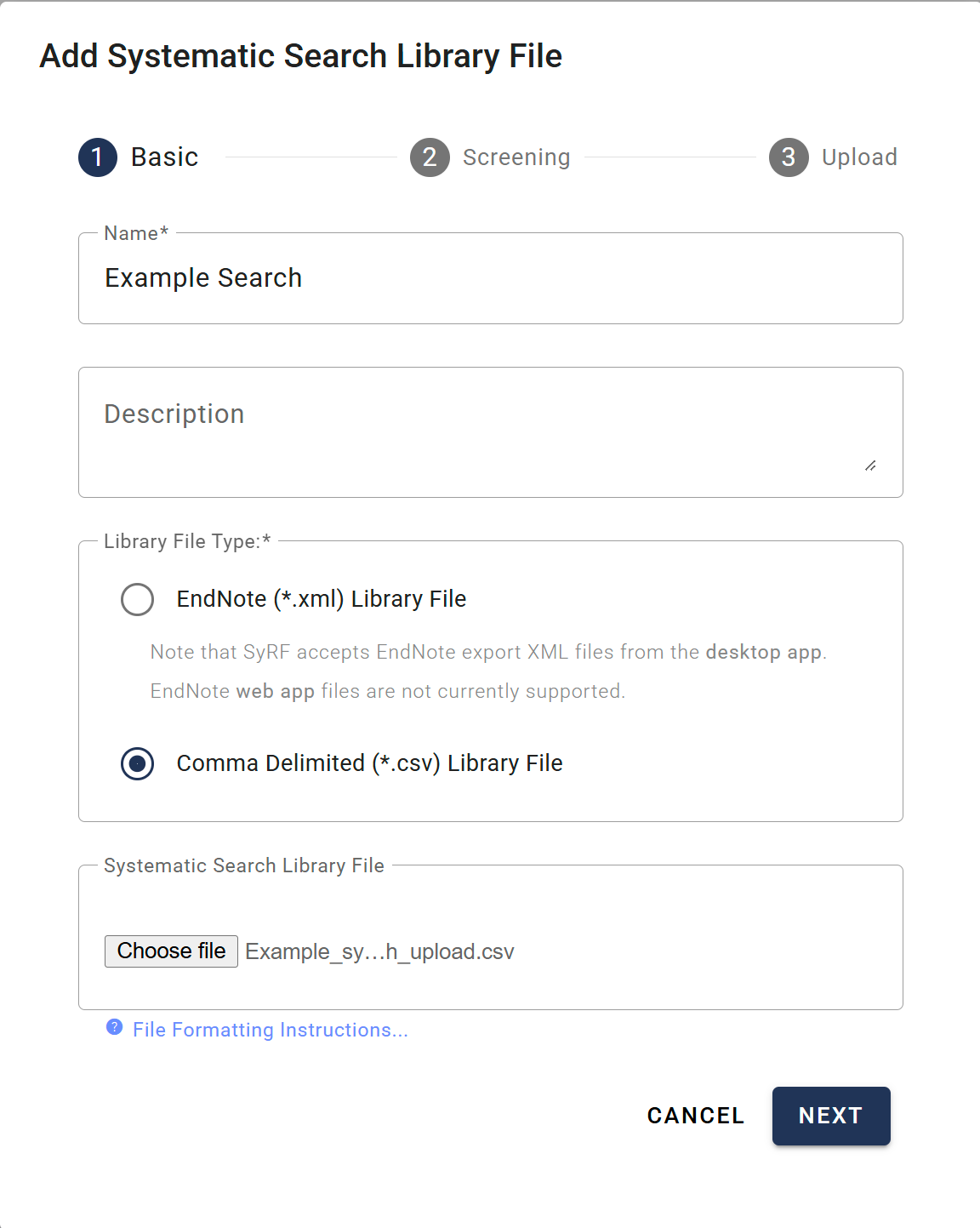
- Name: Enter a descriptive name for your Systematic Search (e.g., “Embase Search May 2024”). This field is required.
- Description: (Optional) Add any relevant details about the search strategy or its contents.
- Library File Type: Select EndNote (
.xml), Comma Delimited (.csv), or Research Information Systems (.ris) to match the file you prepared. SyRF does not auto-detect the format. - Systematic Search Library File: Click Choose File and select the prepared
.xml,.csv, or.risfile from your computer. - Click Next to proceed.
Wizard Step 2: Screening (CSV Uploads Only)
Section titled “Wizard Step 2: Screening (CSV Uploads Only)”This step allows you to map pre-existing screening decisions from your CSV file to project members and screening stages in SyRF.
Note: This step is skipped if you are uploading an EndNote .xml or RIS .ris file.
-
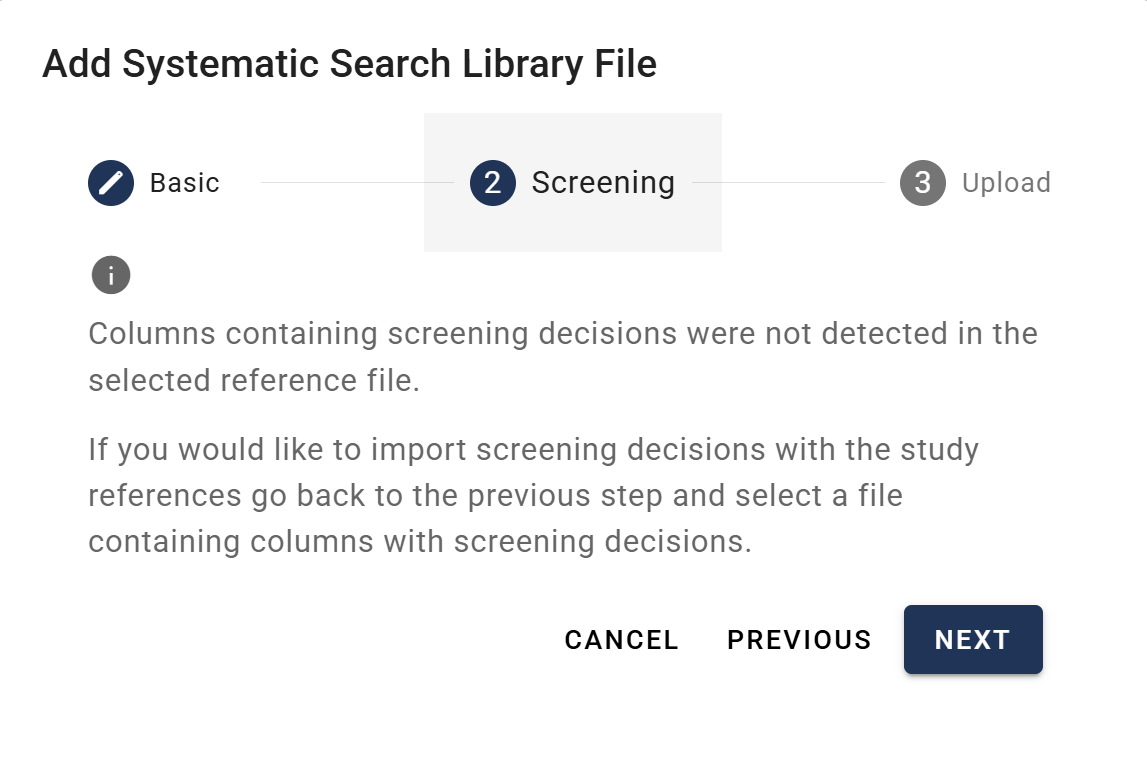
If your CSV file does not contain screening columns: SyRF will inform you that no screening columns were detected. You can simply click Next to continue to the final step.
-
If your CSV file contains screening columns: You must map them before proceeding.

- Stage: Select the screening stage to which the decisions apply (e.g., Title/Abstract Screening, Full Text Screening).
- Map Columns to Investigators: For each screening column detected in your file, SyRF will display the Column heading. From the adjacent Investigator dropdown menu, select the Project Member who made those decisions.
- Once all columns are mapped, click Next.
Wizard Step 3: Upload
Section titled “Wizard Step 3: Upload”This is the final confirmation step.

- Review Details: Carefully review the summary, which includes:
- The Systematic Search Name you provided.
- The File Name, Size, and Type of the file you are uploading.
- A summary of the Screening mappings, showing which column is being mapped to which investigator for the selected stage.
- Begin Upload: If all the information is correct, click Begin upload.
SyRF will now process and import your file. This may take a few moments depending on the number of references.
While the file is sent, the progress bar shows how much has been sent. If the file cannot be sent (for example, because your connection drops), the dialog says “The file could not be sent to SyRF.” with the reason, and a Retry upload button sends it again.
Upon successful upload, the new Systematic Search will appear in the list on the Systematic Searches page, and the included studies will be added to your project’s All Studies list.
If SyRF safely omits an unsupported or invalid optional RIS value, the completed search shows an Import notes button, such as “Import notes (3)”. Each note is one field and reason, for example “Language (LA): not imported into study fields (kept in your original file), 723 records”. Select the button (or focus it and press Enter) to open the same notes panel the import wizard shows, with every note and example record numbers. Hovering or focusing it also shows a preview of up to five notes; any others are summarised as “and N more”. The fields listed are still in your original file, which SyRF keeps as uploaded, but you cannot search them as study fields. Searches imported before import notes existed still show the older warning indicator and its tooltip.
Tracking Progress on the Systematic Searches Page
Section titled “Tracking Progress on the Systematic Searches Page”Current or latest operations
Section titled “Current or latest operations”Above the table, the Current or latest operations panel summarises the work SyRF is doing for this project’s searches right now — both search imports and bulk PDF uploads. While anything is running, every running operation is listed, newest first. When nothing is running, the panel shows the most recent operation so you can see how it ended. If the project has never run either, the panel is not shown at all.
Each entry shows the operation’s status, its name, a one-line detail (such as how far a save has got, or how many PDFs were copied), when it was last updated, and who started it. SyRF only ever reports what it can prove: where the server does not record a time or a person, the entry says Not available rather than guessing.
Who can see search names
Section titled “Who can see search names”If your project uses the Studies workspace, only members who manage searches (by default, the project’s administrators) see its searches. A project administrator who may change permissions can let other groups see the searches’ names and how many studies each one has: on the Searches page, select Who can see search names, choose the groups, and select Save. Those groups see names and study counts only. They can’t import, change or delete searches, or see search files or import notes. Nobody else sees searches unless you choose them.
You can also choose All members. SyRF then warns you that everyone in the project, including reviewers, will see the search names and study counts.
The Status column
Section titled “The Status column”The Status column reports the same states in the same words throughout SyRF:
| Status | What it means |
|---|---|
| Transferring… | Your file is on its way to SyRF. |
| File received. Processing… | SyRF has your file and is checking every reference in it before it adds any. For a large file you see how many references have been checked so far (“2,000 records checked”); there is no percentage yet, because SyRF only knows the total once it has read the whole file. If any reference has a problem, nothing is imported. |
| Saving studies… | SyRF is adding the references to your project, with a progress bar over the total it counted. |
| Complete | Every reference has been imported. |
| Error | The import stopped. Select See reason to read what went wrong. |
| Cancelled for deletion | The import was stopped because you, or another member, deleted the search (or its project) while it was still importing. It is a neutral state, not an error: nothing went wrong with your file. |
| Deleting… | You have deleted this search and SyRF is removing it. Its actions are unavailable until it disappears from the list. |
| Unknown status (n) | A neutral, muted chip shown when your browser does not recognise a status the server reported — usually because SyRF has just been updated. The chip itself does not offer instructions; refreshing the page may pick up the update. |
A completed search that produced import notes or warnings keeps its Complete status and shows the button or indicator described above; notes and warnings never turn a successful import into an error, and their numbers are not counts of failed studies.
Each row shows one status. Once a search has finished importing, it keeps saying Complete, and a short line beneath it shows the state of its bulk PDF upload, if you have used that feature (for example “PDF access verified” or “Uploading PDFs 42%”). Expand the row to see the full PDF detail, including how many PDFs were checked. See Bulk upload PDFs for those states. While the import wizard is still working on a search in this tab, the row also offers the wizard’s next step, such as Review match or Retry PDFs.
Studies without a confirmed PDF
Section titled “Studies without a confirmed PDF”Where your SyRF deployment has the Studies workspace and per-study PDF status switched on, and you manage searches, each search’s Studies count is followed by how many of its studies are without a confirmed PDF, for example 85 without a confirmed PDF. Select it to open Studies showing only that search’s studies without a confirmed PDF. It counts every study whose PDF isn’t Available, including studies with no PDF. It isn’t shown when every study in the search has a confirmed PDF, while the search is still importing, while a PDF upload for it is running, or while it is being deleted. If you can’t open Studies, the number is shown without the link.
The numbers are worked out when you open the page and again when an import or PDF upload finishes or a search is deleted. They don’t change as each PDF check finishes. People who don’t manage searches don’t see them.
Next Steps
Section titled “Next Steps”After uploading your search, you may want to:
- Add PDFs - Link full-text PDFs to your uploaded studies
- View Studies - See your uploaded studies in the project
- Manage Studies - Make bulk updates or corrections if needed
- Glossary - What search, records, studies, attached and the PDF states mean